Monday, January 27, 2014
My New Friend, Abel
Sunday, December 08, 2013
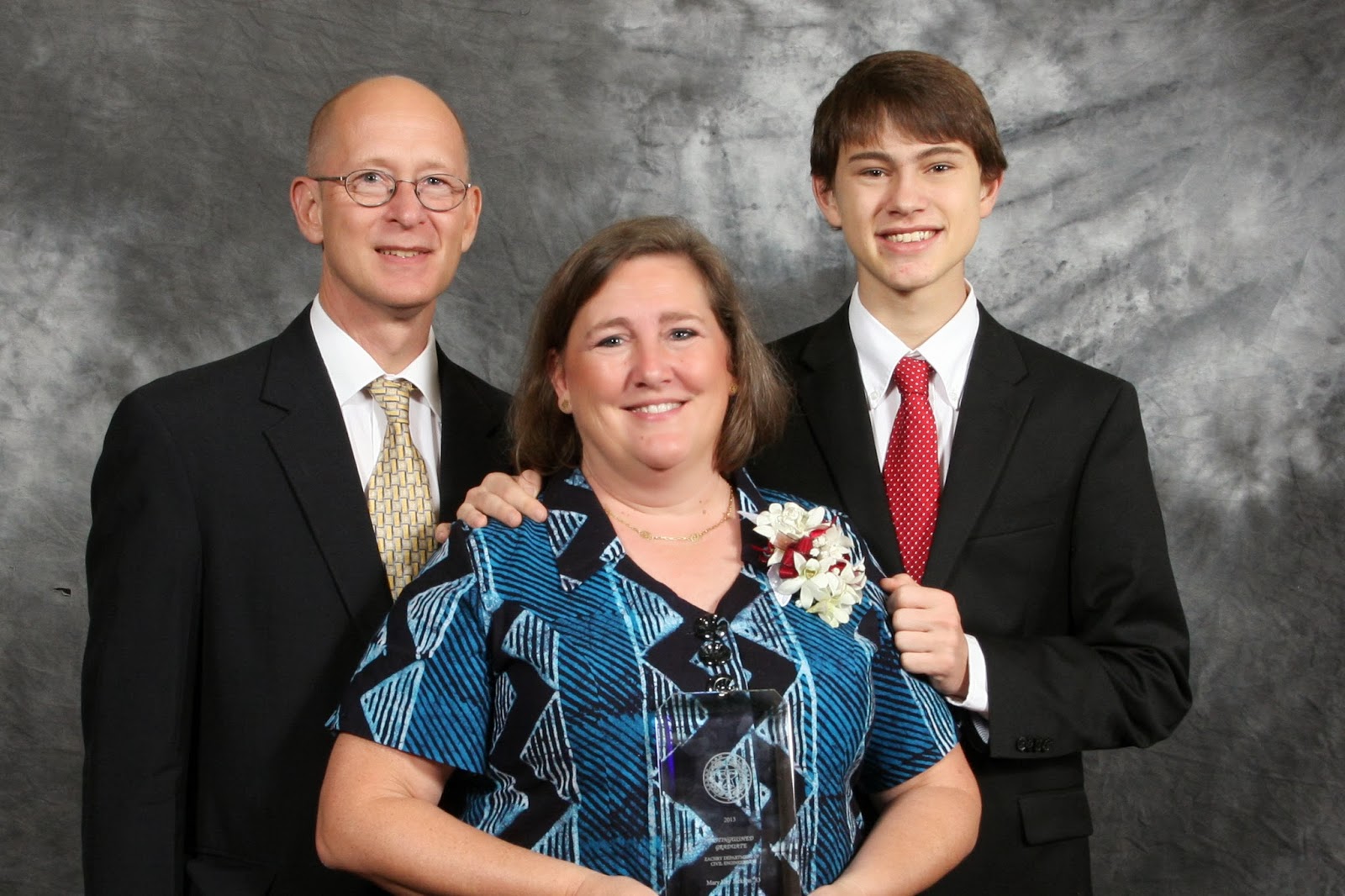
Mary Kay's Aggie Award
Last month, Mary Kay was named a Distinguished Graduate of the Zachary Department of Civil Engineering at her alma mater, Texas A&M University.
Her citation read:
Mary Kay says her civil engineering father, Daniel D. Clinton, Jr. P.E. '52 inspired her to become a civil engineer when he guided her through a 6th grade report on using math in civil engineering. Numerous trips to Aggie football games -- and the family picnics with Tinsley's fried chicken -- sparked her love of A&M traditions and pageantry. When her father said she could go wherever she wanted for college but he only would pay for A&M, she didn't want to call his bluff.
Mary Kay's days at A&M were filled with activities ranging from President of Chi Epsilon, Dean's Student Advisory Council, ASCE, Concrete Canoe Team, to founding member fo the MSC Legislative Forum Group. Her fondest memory is the "Camraderie" of classmates during late night study sessions, slaving in the basement computer lab trying to get a program to run, and building the "Rock" and "Rock-elle" concrete canoes. She says nothing could top "the days when the CEs would take over and open and close the Dixie Chicken and have our big domino tournament. That was what really defined us as CE majors!" She credits Dr. Gene Marquis as a great advisor, friend and mentor. He required hard work and had high expectations "but was always willing to take time to explain a difficult concept to us -- as many times as it took for us to get it."
When she was 35 years old, Mary Kay was named the Design Manager for the F. Wayne Hill Water Reclamation Facility in Atlanta, the first (1997) wastewater treatment plant designed to meet drinking water standards. The facility discharges to the lake that supplies water to much of metropolitan Atlanta. After overcoming many hurdles, the award-winning $200 million project was completed on time and on budget.
As stated in Mary Kay's nomination, "she is doing something that most of us have never done ... using her civil engineering skills to provide people in poverty with safe drinking water and improved living conditions." Mary Kay's biggest career step was leaving the corporate world to use her civil engineering skills in Ghana, West Africa to establish the Methodist Development and Relief Services' water program that has supplied clean, abundant water for rural families. Also under her leadership, a new Pure Home Water charitable organization fabrication facility has been constructed to distribute appropriate technology water filters throughout Ghana.
The Clintons are an Aggie family. Her grandfater helped establish the Texas Agricultural Extension Service. Her father, uncle, sister, brother and now her nephew all wear maroon. Her husband, Dr. Charles W. Jackson, IV, P.E. BSME/MIT, MS, PhD ME/Stanford University is a math professor at Ashesi University in Ghana. Son Chip Jackson is a PhD Aerospace Engineering student at Virginia Tech, and son Ken Jackson has completed his freshman year in Computer Science at the Rose-Hulman Institute of Technology.
We were thrilled that Mary Kay's parents, uncle Kenneth and sister Laura, as well as our son Ken, were able to join with us in the celebration.
Following is her acceptance speech:
Dr Autenrieth, Faculty Members, Students and fellow Aggie CE graduates and supporters, it is a great honor and privilege to be recognized this evening as a Distinguished Graduate of the Zachry Department of Civil Engineering. It is hard to believe that thirty-four years ago, I sat in the atrium of Zachry with several thousand other fish engineers as the Dean of Engineering told us to look at those seated on either side of us -- only one of the three of us would graduate in engineering. It was hard work, with lots of late nights studying, waiting for printouts to see if our computer programs ran, and of course, the nights at the Chicken playing dominoes. But for those of us who graduated four (or five or six) years later, the hard work was worth it. Our time at A&M -- both academic and extracurricular -- shaped who we are today.
I have always wanted to be a civil engineer. My twenty-three year career as a municipal consultant was fulfilling -- all I ever dreamed. I had the opportunity to work with great clients to help solve the challenges posed by the rapid growth in the southeast US in the 80s and 90s. I managed the design of wastewater facilities ranging from 1 MGD to over 200 MGD, and worked on leading edge projects incorporating the use of ozone and membranes into wastewater treatment -- now common practice, but innovative at the time. I loved my work.
But all of this was just the prologue.
According to the WHO/UNICEF Joint Monitoring Report for 2013, about 768 million people, a little over 10% of the world's population, does not have access to adequate supplies of safe drinking water. We have made great strides -- in 2006, there were 1.1 billion people without access to safe water. But there is still a long way to go. And we are not talking about access to 80 gallons per person per day -- the amount we use on average here in the USA. We are talking about the basic human right to a mere 5 gallons per day -- within a 30-minute walk of your home.
At the same time, 2.5 billion people, over one-third of the world's population, do not have the dignity of access to an improved sanitation facility. And over 1 billion of these people practice open defecation - going out into the forest or behind bushes to do their business. All of this results in death, disease and a reduced standard of living for everyone, not just the poorest of the poor. In 2009, the WHO reported that water related disease was the leading cause of death in the world, killing 3.4 million people every year. In Ghana alone, 30,000 children die of preventable diarrheal disease each year. The vast majority of these deaths are children under 5 -- the future of the world.
In 2002, I had the privilege of visiting Ghana for the first time. While our family was there for two weeks on a short mission trip, we fell in love with her tropical climate, warm and friendly people, and rich cultural heritage. But at the same time, we saw villages without water and children drinking from rivers or ponds. At that time, my two boys started asking why children had to live that way and whether or not I could do something about it.
At the same time, I clearly felt the call of God on my life -- to love the least in this world as He loves them. God clearly showed me that while no one is dying of waterborne disease in the US, His children around the world ARE dying. God had given me the talents and A&M had given me the education to be able to make a difference, so what would I do to meet that challenge?
In 2006, I quit my consulting job with Metcalf and Eddy to pursue a new dream. Our family moved to Ghana, where I work with the Methodist Church of Ghana to bring water and sanitation to remote rural villages.
The most fulfilling part of my career is now. It is not the most technologically advanced work - pit latrines and clay or stone pot filters have been in use for thousands of years. But it is the most significant work I will ever do. Whenever I go to a village and distribute ceramic pot filters, or drill a borehole, all the small children gather around. I love to spend time interacting with them -- teaching them a song or just chasing them around the village. But the best part is knowing that these children will now have a much greater chance of growing up to live full and productive lives, all because I have given them a cup of water in Jesus' name.
Living as a missionary in Africa is not everyone's calling. Certainly, if you had told me at graduation that thirty years later I would be telling you these stories, I would have thought you had rocks in your head. But we are all called to care, and we are all called to make a difference in this world. I challenge each of you to find something you are passionate about that makes the world a better place. Dream big -- change the world. You may not be able to change everything, but you will make a difference. And life is much better when you are living your dream and are passionate about what you are doing.
And to God by the glory for all the things I have been able to accomplish.
Thank you.I'm proud of you, Mary Kay!
Sunday, November 24, 2013
A Big Day in Buiyilli
Last week, my friend Reed Hoppe wrote a great article about me for The Mission Society's news feed. I hope you read it through my Facebook or Twitter feeds. If not, you can read it here. I thought you would like to see the next installment of the story.
Today was the big day in Buiyilli. The activity started early at the Pure Home Water office, as our staff assembled and prepared to take 58 filters to the village of Buiyilli in the Tolon District of Northern Ghana. We picked up Jason Von Behren, the American missionary who had identified the need for clean water in Buiyilli and raised the funds for the filters, and set off to the village. Over an hour later, driving down a VERY dusty and bumpy dirt road, we arrived in Buiyilli.
Upon arriving, the PHW staff set things up. This is what 58 filters look like all lined up:
The women started gathering as well. We had asked them to bring soap and basins of water for washing the buckets. We were expecting about 50 women, but had many more than that gather. You can see how poor the water quality in Buiyilli is - and I saw many women and children drink this water during the course of the day. When you are thirsty, sometimes you gotta do what you gotta do!
Peter (in the blue shirt) and Abraham (with the microphone) did a great job of demonstrating how to clean and put the filter together and how to take care of it properly. The village children were restless, of course, but the women listened attentively.
After the demonstration, I gave a small message on Psalm 115 and God's love for the village and Jesus the Living Water. I stressed to the villagers that it was not me or Jason that brought the filters to the village, but God who had heard their pleas for safe water to drink. I also told them that just as they will be proud to share the water from these filters with their visitors as a gesture of hospitality, so too they should share the Living Water of Jesus with their friends and visitors. Everyone that drinks the water should know that it comes from a God who loves the people of Buiyilli and give thanks to Him!
Afterward the women collected their filters, cleaned them and got them ready for use.
The women of Buiyilli wanted to say a big THANK YOU to the donors in Atlanta, Jason, Pure Home Water, and most of all to Jesus for the gift of safe water for themselves and their children!
It was a long, hot day, but finally we had all the filters cleaned and ready to be used. The villagers started heading for their homes, the women carefully carrying their new filters on their heads. And we climbed back in the trucks and started the long, dusty trip back to town.
But I intentionally didn't say I would tell you "the rest of the story" in the first paragraph. I don't know the plans God has for Buiyilli, but I do know that amazing things are happening here, as God brings His Light to a formerly dark corner of the planet. I am grateful that I got to be a little part of Buiyilli's story today.
Sunday, September 29, 2013
Having the name "Charles" in Ghana
On one of my treks about the Accra environs a few weeks ago, I came across a bar west of Korle Bu Hospital whose outer walls had been re-painted courtesy of the Club brewery. Since it was in my favorite color, green, and had my name on it, I just had to stop and take a photo!
Having the name "Charles" in Ghana means that you will use that form, rather than "Charlie," since the name "Charlie" (pronounced, and sometimes even spelled "Chale") would be used in the sense of "friend" as painted here. In fact, the "flip-flops" that most people here wear are called "Chale Wotes." Accra even has a street art festival called that, see photo below, their facebook page and their Twitter hashtag #chalewote.
A good name is to be chosen rather than great riches, and favor is better than silver or gold.
Proverbs 22:1 ESV
Monday, June 17, 2013
Your True Love Has Produced Real Testimonies
![]() |
| Pastor Peter Awane and his family |
![]() |
| The Primary School at Peter's ministry complex |
YOUR TRUE LOVE HAS PRODUCED REAL TESTIMONIES.
![]() |
| The ancestral well near Peter's property |
| Kids from Peter's school enjoy the safe water from their new borehole. |
Wednesday, April 03, 2013
Meanwhile, I was a guest blogger on the Shine Girls (we're shining for Jesus) blog by Jillian Hill last week. You can read here about how the Shine Girls celebrated World Water Day, without even knowing it!
Somewhere I hear birds chirping, a sweet song for only my ears. I lie, listening, when a rustle of palm trees joins in. With the rhythm of the wind accompanying the birds, our secret band is almost complete. Ah, there it is – the cock-a-doodle-doo of one of the many neighborhood roosters. The group quietly demands an audience – I couldn’t leave now! I lie still a little longer.
I realize that the sun no longer covers my face. That warm feeling only lasts for 15 minutes, due to the sun’s angle and the closeness of Ghana to the equator. Now my ceiling fan, currently set to five – or ‘hurricane mode’ – sends a cool tingling sensation through my body. The fan creates a trance-like state, blocking all outside noise with its ample whooshing. I stare at the rapidly spinning blades, hypnotizing myself into a place where time ceases to exist. I focus entirely on the fan, reinvigorated by the energetic cyclone it creates. I really should get up. I lie still a little longer.
I must have nodded off; the sun no longer reaches my curtains. I am aroused by music coming from my iPod – my mother’s small playlist of ‘Hip music’ is set to wake me. It is fast-paced music, with strong rhythms and catchy melodies. My body demands action at this point; I can no longer lie still. I get out of bed and put on the first clothes I find, a plain t-shirt and some mesh shorts. I exit my room and walk down the hall to the kitchen, where my mother hugs me and offers me some French toast. This is an interesting variety, made from bread with sugar initially cooked into it. The soft, moist sweetness is quickly shoveled into my mouth – covered, of course, with a large dose of maple syrup. I down it all with a glass bottle of Coke. Ah, that’s satisfying. With that, I can take on any kind of day!
Saturday, March 16, 2013
Walking the dog at ACP Estates
When Mary Kay and I returned from a birthday getaway to the beach at Anomabo, just outside Cape Coast, I was able to return to my usual walking routine with Ziker, our beloved African-American dog. [We say this because while in the States, he seemed somewhat unusual (just a yellow dog from the pound), when we arrived in Ghana, it seemed every third dog roaming the streets was his brother!]

As is usual when I take these walks around our new neighborhood outside Pokuase, there are new plants to see. This time, the new ones were smallish trees that were bearing large numbers of yellow, cherry-sized fruit, that were covering a bright red seed.
The weight of the fruit was so much that the trees were really sagging:![]() |
| Laden branches |
![]() |
| A row of such trees, 3-4 meters high. |
We also passed some Bougainvillea thorn bushes, which have the craziest colors:
as well as some ripe palm oil nuggets and a bright red hibiscus flower:
Matthew 6:25-33 (ESV)"Therefore I tell you, do not be anxious about your life, what you will eat or what you will drink, nor about your body, what you will put on. Is not life more than food, and the body more than clothing? Look at the birds of the air: they neither sow nor reap nor gather into barns, and yet your heavenly Father feeds them. Are you not of more value than they? And which of you by being anxious can add a single hour to his span of life? And why are you anxious about clothing? Consider the lilies of the field, how they grow: they neither toil nor spin, yet I tell you, even Solomon in all his glory was not arrayed like one of these. But if God so clothes the grass of the field, which today is alive and tomorrow is thrown into the oven, will he not much more clothe you, O you of little faith? Therefore do not be anxious, saying, 'What shall we eat?' or 'What shall we drink?' or 'What shall we wear?' For the Gentiles seek after all these things, and your heavenly Father knows that you need them all. But seek first the kingdom of God and his righteousness, and all these things will be added to you."
Friday, March 08, 2013
Late Luggage, Ghana style...
Charlie writes:
![]() |
| Rolling along the main highway with our five bags |
![]() |
| Inside the Domestic Terminal |
![]() |
| Back to the truck, off to lunch... |
![]() |
| The second porter on that leg... |
![]() |
| Back the last time... |
Church in Wildwood, outside St. Louis, Missouri, returned
for another visit to their friends in northern Ghana.
Mary Kay is escorting them this week, along with Nana,
the driver from the Methodist Church of Ghana. You can
read more about their trip at their Ghana Project website.
Unfortunately, there were five pieces of luggage that did not
make the short transfer interval at London's Heathrow Airport.
In fact, the team almost got cut in half when the pastor was
pulled aside for a thorough examination. The team members
were used to this happening, and were prepared to file
the appropriate papers at the late/lost luggage counter
downstairs at the Accra airport.
I should have checked the next evening to find all the bags,
but instead, Mary Kay had to remind me that the team was
looking forward to distributing some things from those very
bags to the place they were visiting on Tuesday, so I had better
go down and deal with it on Monday. The luggage handlers had
called her to confirm that all the bags had arrived on the
Sunday evening flight, so they just needed to be picked up.
Having had experience with this on a prior trip, I made
sure that I had xerox copies of the photo and visa pages
of the relevant passports. When I arrived, they were expecting
me. We were able to find the five bags based on the descriptions
on the forms and confirmed via the tags. I signed the register,
then opened each bag for the Customs officer on duty.
Next, I rounded up a cart, and loaded the bags up for the
walk to the local flights terminal. One of the porters
saw me struggling, so came along and relieved me of the
pushing - rolling the cart right along the main road
through the airport with honking taxis upset at him.
Arriving near the terminal, my pushers got nervous and
asked for pay before they would be seen by the police
or the other porters. So that meant another porter being
retained for the last bit.
Inside the terminal, I was directed to ask at the ticketing
counters for arrangement of transport for the bags up to
the Tamale airport. They directed me to the check-in stands,
and when I got to the front of the line, they directed me
to another, and that fellow called someone, returning with
the message "we don't take unaccompanied luggage!" I begged
him to check the other carriers, and the fellow at Starbow
was willing to accept the packages. He explained that they
would be carried for a fee of three ghana cedi per kilogram,
so he recommended I weigh them first so I would know the
charges. Since they were 70 kg, I would be owing GHS 210.
However, the space in the terminal was so limited that he
would not accept them until an hour or so before scheduled
departure. Thus, I rolled them all back to the Hilux and went
to lunch. Then I bought some neon green paper and scissors
and cello tape, preparing labels for the bags to make them
easy for Mary Kay to identify at the Tamale airport.
The drop-off went smoothly, and they issued me the required
claim tags. When I asked how Mary Kay would get the bags since
I obviously was not going to be able to get the tags to her,
I was told that if she knew the numbers, and showed ID, they
would let her take the bags. So, I called her with the numbers.
![]() |
| The stack of luggage claim tags |
![]() |
| All five bags made it! |
![]() |
| The original receipt had been for GHS 410, so I requested another! |
Meanwhile, up in Tamale, Mary Kay was trying to figure out
how to get to the baggage area, since that airport only
has an exit from that area, so that only passengers can enter.
The flight was delayed half an hour, but eventually it arrived
and the team was able to make their way to Navrongo, arriving
at 8:30 p.m. Mary Kay passed the phone around
the Coaster bus, and I was gratified by the expressions
of thanks from all those involved.
Later that evening, I was back at the airport (on my third
visit to the parking area, the ticket-taker took pity on me
and let me come in without paying) and visited the BA ticket
office to see about getting reimbursed for the extra transport.
"Go to our offices over domestic terminal for that, sir,"
was my advice. There, I was attended to by a friendly rep
who informed me that such refunds were not allowed by airline
rules in West Africa. [This is just one of many examples of
the special treatment offered citizens of countries with
reputations for scams and lies.] She assured me that if
proper documentation were presented in either the UK
or the USA, the airline would make good on the extra
expenses caused by the late arrival of bags.
That meant I had to make another trip down to the
lost luggage counter, and after diving into a cardboard
box under the desk, we were able to recover the original
forms. The agent went with me to the internet cafe
in arrivals area of the airport to make copies.
Now I have to remember to make scans and deliver
to the team so they can follow up once they are
back in the US.
So, a transaction that would be handled over the phone and
result in the personal delivery of late bags to the hotel
ended up taking the better part of a day. As Chip would say,
"T.I.G." (This Is Ghana).
Genesis 32:13-21 (Jacob and his luggages)
So he stayed there that night, and from what he had with him he took a present for his brother Esau, two hundred female goats and twenty male goats, two hundred ewes and twenty rams, thirty milking camels and their calves, forty cows and ten bulls, twenty female donkeys and ten male donkeys.
These he handed over to his servants, every drove by itself, and said to his servants, "Pass on ahead of me and put a space between drove and drove."
He instructed the first, "When Esau my brother meets you and asks you, 'To whom do you belong? Where are you going? And whose are these ahead of you?' then you shall say, 'They belong to your servant Jacob. They are a present sent to my lord Esau. And moreover, he is behind us.'"
He likewise instructed the second and the third and all who followed the droves, "You shall say the same thing to Esau when you find him, and you shall say, 'Moreover, your servant Jacob is behind us.'" For he thought, "I may appease him with the present that goes ahead of me, and afterward I shall see his face. Perhaps he will accept me."
So the present passed on ahead of him, and he himself stayed that night in the camp.
Thursday, February 28, 2013
For want of $400...
| Emirita Professor Nana Araba Apt |
| Matthew Christopher Taggart |
![]() |
| Prof. Astrid Tweneboah Larssen |
Yesterday evening, the Ashesi community said farewell to three
long-term staffers, Emerita Professor Nana Araba Apt, Matthew Christopher Taggart, and his wife, Professor Astrid Tweneboah Larssen. As part of the celebrations, Ashesi's founder, Patrick Awuah revealed the truth about early days.
Actually, Matt was Patrick and Nina's first employee before
the college opened its doors. Over the intervening twelve
years, Matt has spearheaded Ashesi's fundraising efforts, helping to raise over $20 million in funds for construction of the campus and funds for scholarships. Patrick remarked that his arrival prompted a move from an office over the Red Door Tavern to another, about the size of Ashesi's current reception lobby, on the fourth floor of a Seattle movie theatre.
Patrick's emotions caught up with him as he recalled times he had cowered under his desk in that office, his legs pressed against the desktop from below, shaking with fear. He also recalled Matt fussing at him from under a table for standing by the window of that office looking at construction cranes swaying during a magnitude 7 earthquake! He also shared a story that inspired the title of this post. As he considered what event was the seed for Ashesi, he realized he needed to tell the story of his admission to Swarthmore College outside Philadelphia.
I had heard that Patrick, having graduated from the Achimota School, had been encouraged to apply to Swarthmore by the US Embassy college office which was in the building now occupied by the Barclay's bank adjacent AU Circle in Accra. Yesterday, we heard "the rest of the story."
Patrick told how he had received an offer of admission from Swarthmore, which at the time cost about $15,000 a year. The offer was accompanied by a scholarship covering all but $100 of those expenses. He excitedly prepared paperwork for a visa to travel to the USA, only to be rejected. When he asked why the application had been refused, he was told of the policy that students requesting permission to attend college in the USA were expected to document bank assets covering the family's total financial obligations for the student's four years expenses in advance.
Patrick explained that his parents had only enough in the bank to cover one year. He elaborated for his audience's consideration that in those days, Ghanaians were in economic distress. Finding money to buy food for the week was a challenge, never mind the astronomical sum of $400 for college tuition.
He argued, "if you let me go to the USA, I will be able to find some way to make the other $300." Still no dice, no exceptions would be made.
Crestfallen, Patrick had to write Swarthmore, appealing to them to reduce his family's contribution to his fees by a factor of four so he could get a visa. After an anxious wait, his family received another offer letter from the college, with a scholarship covering all of Patrick's expenses. As Patrick remarked, "we could handle four times zero, even if we couldn't cover four times $100." So he was able to re-apply to the visa section, got his visa, and began his college career that fall.
Patrick ruminated that an "invisible hand" had reached across the ocean and pulled him though a life-changing experience. A person or people unknown to him had donated money to the college. The college had awarded that money to his family without the donors knowing them, either. What a concept! He noted that recent alumni newsletters reported twenty million and fifty million dollar gifts being made for these "invisible hands" from Swarthmore in recent times.
He challenged the hundreds of students in the Cornfield Courtyard gathered to hear his address with the vision that some of them, come 20 or 30 years, would remember their Ashesi experiences, and provide the funds for a similar "invisible hand" for an unknown student to attend their alma mater.
Patrick noted that Matt had decided a few years into the project that Ashesi could not afford to pay him a salary that would support him in Seattle, and offered to relocate to Ghana to save the college precious funds. He recalled going back to Seattle, packing up their office, donating furniture to charities and closing up their office over the theatre.
Then, as we had heard before, came the December when the executive team had to postpone their paychecks. Yet, Patrick said the idea of stopping financial aid was never seriously considered, recalling the importance that "invisible hand" had meant to him and his family. A school dedicated to the vision of raising a new generation of ethical, entrepreneurial leaders for the transformation of a continent had to make provision for those unable to afford the cost to be extended that opportunity.
While Patrick admitted that he hadn't had to ride horseback, hat in hand, as had Edward Parrish the first president of Swarthmore College nearly 150 years ago, he already had international bookings in the first ten months of 2013, and November was filling in. He vowed to keep December free for his family here in Ghana, but understood the vital need to keep raising the capital funds to cover the construction of the planned engineering expansion.
"We claim a higher mission for Swarthmore College than that of fitting men and women for business. It should fit them for life, with all its possibilities." - Edward Parrish
Later in the evening, Matt delivered a heart-felt impromptu message, admitting that the twelve years at Ashesi had made him the man he is today. He met his wife, had two children, and was able to invest his work in an idea that he was passionate about. He encouraged all hearers that he wished for them the joy of finding passion in their work, and pledged to continue to support Ashesi in the future.
Patrick surprised Nana Apt by unveiling a plaque naming the lecture hall 218, the one near the canteen, in her honor. In her address, Nana was clearly touched, saying "usually, you don't live to see this sort of honor!"
Mary Kay has been reading a book called The Idea Factory: Bell Labs and the Great Age of American Innovation by Jon Gertner. She and I spent the evening talking of the "lore" of places like Bell Labs and MIT, and we realized that these stories are a huge part of the legacy founders make to those places. I certainly will not soon forget the image of the $400 that seemed to be the insurmountable barrier to Patrick's dreams.
Thank you Nana, Matt and Astrid for your parts in the Ashesi story! You will always be a part of our legend.
Only take care, and keep your soul diligently,lest you forget the things that your eyes have seen,
and lest they depart from your heart all the days of your life. Make them known to your children and your children's children. Deuteronomy 4:9 (ESV)
Friday, November 09, 2012
Wow - it has been a long time since we have posted anything. I have to say that I have been traveling virtually non-stop since the last post, and Charlie has been trying hard to keep his head above water, between his teaching and trying to keep up with all the essential tasks I kept assigning him from abroad.
Since Halloween, we and our organizations have been featured in several social media venues. I thought I would share these glimpses into our lives in Africa with you.
The first mention came from a friend of mine, Jen Shank, on her site, Swanky Shank. Jen is a member of one of our supporting churches, Living Word UMC, and runs an on-line business from her home in the St. Louis area. Jen honored us with her creation of the month, bracelets featuring Ghanaian glass beads and is donating the proceeds from the bracelets to the Ghana Project, which funds water projects in northern Ghana. Jen is really creative and has cute stuff, so take a look. I don't benefit from her sales - except the bracelets, which really will benefit the children of northern Ghana, not me.
Last Friday, I was given the opportunity to guest blog on the Shine Girls Shine website. Shine Girls Shine is a daily Bible reading and prayer ministry. I follow it to help keep me accountable in my daily devotions. I have gained so much - it is amazing how often the blog posts are right on target with something going on in my life. It was a privilege to share a part of our story of our call to Ghana with the Shine Girls.
Most of you probably know that one of the hats I wear is as Managing Director of Pure Home Water, a Ghanaian non-profit that manufactures and distributes ceramic pot filters to rural households so that they can have safe water to drink. A very talented friend of ours, Iaona Lupascu, of SparkIntuit created a wonderful 4 minute documentary on Pure Home Water.
Finally, Patrick Awuah, the founder of Ashesi University, where Charlie teaches, is being honored today by the Haas School of Business at University of California, Berkeley with their prestigious Innovation Award. You can learn more about Ashesi and Patrick's vision to change Ghana one student at a time in this news report.
Tuesday, July 31, 2012
Recycling in Accra
After several months of back and forth with the manufacturer of the Pure Home Water lids stashed on our front porch, Mary Kay finally gave up and authorized me to figure out a way to clear them out. The new clay pot filters from the factory in Tamale are a different size, so the lids we had from before just won't work, and the plastics maker here wasn't willing to take them back, since they really aren't worth much without a matching bottom.
I was not looking forward to the exercise, since recycling is not done in the same way here in Accra as it would be in Atlanta. In Atlanta, I knew the various places that glass, metals, or plastics could be taken for recycling, but not here.
After a few minutes, though, I remembered that I had seen a man cutting up the yellow jerrycans that hold cooking oil in a lot not too far from our house. He and his assistant seemed to be breaking them down into flat pieces and then lashing them together in piles to be sold to plastics manufacturers across town. I thought I would wander by and ask if they would take this sort of plastic as well.
When I got there, a crew of about six young men were just pulling in with one of those four-wheeled carts that you see all about town, topped by three large white tyvek bags filled with miscellaneous plastics, and a number of "Go Bags" that were stuffed with more plastic. They untied the bags and tossed them on the ground, then used an S-shaped hook to attach the bags one at a time to a spring scale hanging from a crossbar about six feet off the ground. Then the man running the recycling center scribbled his sums in a small pad and paid the head hauler, who then passed some on to all the "boys" who had helped collect and escort the cart. The cart owner then left to gather up more from the neighborhood.
After they had finished, I approached the owner. He looked at the lid, telling me that he would pay fifty pesewas per kilogram for that sort of plastic. I enlisted two of the hangers-on to walk back to our house with two huge tyvek bags. They neatly stuffed all the lids into the bags, but then realized that they wouldn't be able to hoist them on their heads as I think they had anticipated. So I backed the Hilux over and they loaded them in the pickup bed, supervised by Jonas and Jasper. A few minutes later we were back at the lot, and the owner helped wrestle the bags into position for weighing. Mary Kay was pleasantly surprised to receive cash back for what was no longer usable, and I was amused that the scrap vendor paid the 92 ghana cedis with 92 red one cedi notes. That's about the first business I've run into in Ghana that carries exact change!
The students from CMU have been running a demonstration plastic bottle recycling program at Ashesi, not sure where the bottles go, but I had read somewhere that an NGO was collecting them to use as floats in creating netted fish hatcheries in Lake Volta, which sounded interesting.
Now if we can just figure out what to do with glass and aluminum...
Wednesday, July 25, 2012
Seawater Desalination Coming to Teshie
Charlie writes:
A few weeks ago on my usual weekend bicycle ride, I tried to find the Ramada Inn that is east of Accra on Coco Beach. Was unable to on bicycle, but later Mary Kay and I drove over, and spent a holiday afternoon there. But the topic of this post is the new water project that I discovered. I've not heard anything of it in the local media. Today, I bicycled back over, and met with Carlos, one of the engineers from Abengoa Water, a Spanish firm that is heading up a desalination project in Teshie, an eastern suburb of Accra, the nation's capital. Carlos was pacing the property, with a clipboard on which he was counting the trucks as they went in and out of the compound. As he explained to me, the site had been used as an unofficial landfill, so the first step is to build a wall, install concertina wire and gates, and provide manned security to discourage the addition of any more trash to the property. They had been given assurances that the place they were hauling truckloads of black sand in Tema, further east, had been declared a legitimate landfill, but hadn't seen official documents of that claim yet.When I asked how much water this plant was to be providing to this part of Accra, the answer was "Just read it off the sign, isn't it out there?" We walked outside the gate and as you can see in the photo, there was no mention of the size or date. Carlos then admitted that the plant was designed to produce 60,000 cubic meters of potable water per day, and that if everything goes well, it should begin operating in about two years. As a point of comparison, I found a report suggesting that in 2008, GWCL had contracted for a 20,000 cubic meters per day plant in Teshie, with a 25-year BOO plan with Aqualyng Ghana Limited, which I suppose has lapsed. That was projected to supply enough water for just 4% of metro Accra, which would be 1 or 2% by 2030. Sounds like this plant is 3 times that. Abengoa claims to have built plants in Spain, Algeria, India, and China with a combined capacity of 875,000 cubic meters per day, so this is a modest sized one.
He and I compared traffic stories. Carlos decided to settle in Osu, where he could get about without needing an auto, and could find good food and nightlife. His firm supplied him a driver and auto, and he can make it from home to work in 45-60 minutes. The beach road widening is nearly finished, just a few hundred yards of road where the dual-carriage merges onto one side just east of the Kofi Annan Peacekeeping Training Center. Both our commutes are reverse the normal direction, although mine is closer to 90 minutes.
Apparently the plan is to submerge a large pipe under the beach there, and withdraw seawater. Then it will be forced through membranes at high pressures to separate the salt. He didn't say what other processes would be used, but I would imagine that chlorination or UV disinfection might be required, since the city of Accra discharges only partially treated wastewater into the ocean at a point that Google Earth computes at 17.12 km away. [Google Earth kml file here].
The civil work was being done by the same outfit that had constructed the Ashesi campus in Berekuso, so their foreman recognized my t-shirt. They are planning to finish securing the perimeter in the next few weeks.
With the unreliability of electricity in the area, I'm not sure how practical a desal plant will be, but perhaps they will build a large diesel powerplant to carry them over power cuts. That would be very expensive, though.
Saw the following advert on my way home on a tavern wall. Ghanaians are often surprised that I would call myself "Charlie" for this reason, since it is kind of like "Bud" or "Buster" in the USA.
Exo 15:23-27 GNB
Then they came to a place called Marah, but the water there was so bitter that they could not drink it. That is why it was named Marah. The people complained to Moses and asked, "What are we going to drink?" Moses prayed earnestly to the LORD, and the LORD showed him a piece of wood [moringa?], which he threw into the water; and the water became fit to drink. There the LORD gave them laws to live by, and there he also tested them. He said, "If you will obey me completely by doing what I consider right and by keeping my commands, I will not punish you with any of the diseases that I brought on the Egyptians. I am the LORD, the one who heals you." Next they came to Elim, where there were twelve springs and seventy palm trees; there they camped by the water.