![]() |
| Pastor Peter Awane and his family |
![]() |
| The Primary School at Peter's ministry complex |
YOUR TRUE LOVE HAS PRODUCED REAL TESTIMONIES.
![]() |
| The ancestral well near Peter's property |
| Kids from Peter's school enjoy the safe water from their new borehole. |
Join us on our faith journey as we follow Jesus to
![]() |
| Pastor Peter Awane and his family |
![]() |
| The Primary School at Peter's ministry complex |
![]() |
| The ancestral well near Peter's property |
| Kids from Peter's school enjoy the safe water from their new borehole. |

As is usual when I take these walks around our new neighborhood outside Pokuase, there are new plants to see. This time, the new ones were smallish trees that were bearing large numbers of yellow, cherry-sized fruit, that were covering a bright red seed.
The weight of the fruit was so much that the trees were really sagging:![]() |
| Laden branches |
![]() |
| A row of such trees, 3-4 meters high. |
Matthew 6:25-33 (ESV)"Therefore I tell you, do not be anxious about your life, what you will eat or what you will drink, nor about your body, what you will put on. Is not life more than food, and the body more than clothing? Look at the birds of the air: they neither sow nor reap nor gather into barns, and yet your heavenly Father feeds them. Are you not of more value than they? And which of you by being anxious can add a single hour to his span of life? And why are you anxious about clothing? Consider the lilies of the field, how they grow: they neither toil nor spin, yet I tell you, even Solomon in all his glory was not arrayed like one of these. But if God so clothes the grass of the field, which today is alive and tomorrow is thrown into the oven, will he not much more clothe you, O you of little faith? Therefore do not be anxious, saying, 'What shall we eat?' or 'What shall we drink?' or 'What shall we wear?' For the Gentiles seek after all these things, and your heavenly Father knows that you need them all. But seek first the kingdom of God and his righteousness, and all these things will be added to you."
![]() |
| Rolling along the main highway with our five bags |
![]() |
| Inside the Domestic Terminal |
![]() |
| Back to the truck, off to lunch... |
![]() |
| The second porter on that leg... |
![]() |
| Back the last time... |
![]() |
| The stack of luggage claim tags |
![]() |
| All five bags made it! |
![]() |
| The original receipt had been for GHS 410, so I requested another! |
So he stayed there that night, and from what he had with him he took a present for his brother Esau, two hundred female goats and twenty male goats, two hundred ewes and twenty rams, thirty milking camels and their calves, forty cows and ten bulls, twenty female donkeys and ten male donkeys.
These he handed over to his servants, every drove by itself, and said to his servants, "Pass on ahead of me and put a space between drove and drove."
He instructed the first, "When Esau my brother meets you and asks you, 'To whom do you belong? Where are you going? And whose are these ahead of you?' then you shall say, 'They belong to your servant Jacob. They are a present sent to my lord Esau. And moreover, he is behind us.'"
He likewise instructed the second and the third and all who followed the droves, "You shall say the same thing to Esau when you find him, and you shall say, 'Moreover, your servant Jacob is behind us.'" For he thought, "I may appease him with the present that goes ahead of me, and afterward I shall see his face. Perhaps he will accept me."
So the present passed on ahead of him, and he himself stayed that night in the camp.

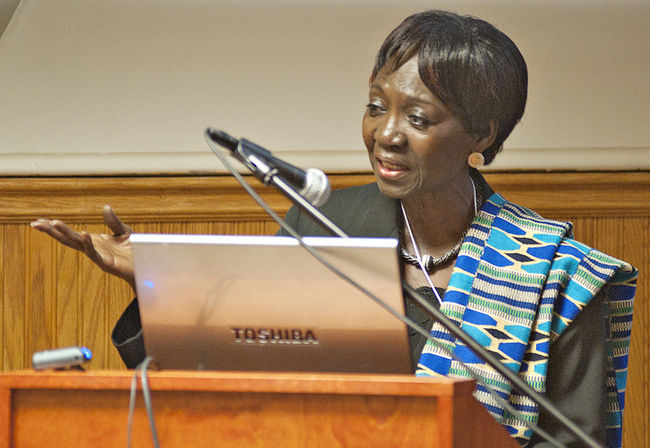
| Emirita Professor Nana Araba Apt |
| Matthew Christopher Taggart |
![]() |
| Prof. Astrid Tweneboah Larssen |
"We claim a higher mission for Swarthmore College than that of fitting men and women for business. It should fit them for life, with all its possibilities." - Edward Parrish
After several months of back and forth with the manufacturer of the Pure Home Water lids stashed on our front porch, Mary Kay finally gave up and authorized me to figure out a way to clear them out. The new clay pot filters from the factory in Tamale are a different size, so the lids we had from before just won't work, and the plastics maker here wasn't willing to take them back, since they really aren't worth much without a matching bottom.
I was not looking forward to the exercise, since recycling is not done in the same way here in Accra as it would be in Atlanta. In Atlanta, I knew the various places that glass, metals, or plastics could be taken for recycling, but not here.
After a few minutes, though, I remembered that I had seen a man cutting up the yellow jerrycans that hold cooking oil in a lot not too far from our house. He and his assistant seemed to be breaking them down into flat pieces and then lashing them together in piles to be sold to plastics manufacturers across town. I thought I would wander by and ask if they would take this sort of plastic as well.
When I got there, a crew of about six young men were just pulling in with one of those four-wheeled carts that you see all about town, topped by three large white tyvek bags filled with miscellaneous plastics, and a number of "Go Bags" that were stuffed with more plastic. They untied the bags and tossed them on the ground, then used an S-shaped hook to attach the bags one at a time to a spring scale hanging from a crossbar about six feet off the ground. Then the man running the recycling center scribbled his sums in a small pad and paid the head hauler, who then passed some on to all the "boys" who had helped collect and escort the cart. The cart owner then left to gather up more from the neighborhood.
After they had finished, I approached the owner. He looked at the lid, telling me that he would pay fifty pesewas per kilogram for that sort of plastic. I enlisted two of the hangers-on to walk back to our house with two huge tyvek bags. They neatly stuffed all the lids into the bags, but then realized that they wouldn't be able to hoist them on their heads as I think they had anticipated. So I backed the Hilux over and they loaded them in the pickup bed, supervised by Jonas and Jasper. A few minutes later we were back at the lot, and the owner helped wrestle the bags into position for weighing. Mary Kay was pleasantly surprised to receive cash back for what was no longer usable, and I was amused that the scrap vendor paid the 92 ghana cedis with 92 red one cedi notes. That's about the first business I've run into in Ghana that carries exact change!
The students from CMU have been running a demonstration plastic bottle recycling program at Ashesi, not sure where the bottles go, but I had read somewhere that an NGO was collecting them to use as floats in creating netted fish hatcheries in Lake Volta, which sounded interesting.
Now if we can just figure out what to do with glass and aluminum...
Charlie writes:
A few weeks ago on my usual weekend bicycle ride, I tried to find the Ramada Inn that is east of Accra on Coco Beach. Was unable to on bicycle, but later Mary Kay and I drove over, and spent a holiday afternoon there. But the topic of this post is the new water project that I discovered. I've not heard anything of it in the local media. Today, I bicycled back over, and met with Carlos, one of the engineers from Abengoa Water, a Spanish firm that is heading up a desalination project in Teshie, an eastern suburb of Accra, the nation's capital. Carlos was pacing the property, with a clipboard on which he was counting the trucks as they went in and out of the compound. As he explained to me, the site had been used as an unofficial landfill, so the first step is to build a wall, install concertina wire and gates, and provide manned security to discourage the addition of any more trash to the property. They had been given assurances that the place they were hauling truckloads of black sand in Tema, further east, had been declared a legitimate landfill, but hadn't seen official documents of that claim yet.When I asked how much water this plant was to be providing to this part of Accra, the answer was "Just read it off the sign, isn't it out there?" We walked outside the gate and as you can see in the photo, there was no mention of the size or date. Carlos then admitted that the plant was designed to produce 60,000 cubic meters of potable water per day, and that if everything goes well, it should begin operating in about two years. As a point of comparison, I found a report suggesting that in 2008, GWCL had contracted for a 20,000 cubic meters per day plant in Teshie, with a 25-year BOO plan with Aqualyng Ghana Limited, which I suppose has lapsed. That was projected to supply enough water for just 4% of metro Accra, which would be 1 or 2% by 2030. Sounds like this plant is 3 times that. Abengoa claims to have built plants in Spain, Algeria, India, and China with a combined capacity of 875,000 cubic meters per day, so this is a modest sized one.
He and I compared traffic stories. Carlos decided to settle in Osu, where he could get about without needing an auto, and could find good food and nightlife. His firm supplied him a driver and auto, and he can make it from home to work in 45-60 minutes. The beach road widening is nearly finished, just a few hundred yards of road where the dual-carriage merges onto one side just east of the Kofi Annan Peacekeeping Training Center. Both our commutes are reverse the normal direction, although mine is closer to 90 minutes.
Apparently the plan is to submerge a large pipe under the beach there, and withdraw seawater. Then it will be forced through membranes at high pressures to separate the salt. He didn't say what other processes would be used, but I would imagine that chlorination or UV disinfection might be required, since the city of Accra discharges only partially treated wastewater into the ocean at a point that Google Earth computes at 17.12 km away. [Google Earth kml file here].
The civil work was being done by the same outfit that had constructed the Ashesi campus in Berekuso, so their foreman recognized my t-shirt. They are planning to finish securing the perimeter in the next few weeks.
With the unreliability of electricity in the area, I'm not sure how practical a desal plant will be, but perhaps they will build a large diesel powerplant to carry them over power cuts. That would be very expensive, though.
Saw the following advert on my way home on a tavern wall. Ghanaians are often surprised that I would call myself "Charlie" for this reason, since it is kind of like "Bud" or "Buster" in the USA.
Exo 15:23-27 GNB
Then they came to a place called Marah, but the water there was so bitter that they could not drink it. That is why it was named Marah. The people complained to Moses and asked, "What are we going to drink?" Moses prayed earnestly to the LORD, and the LORD showed him a piece of wood [moringa?], which he threw into the water; and the water became fit to drink. There the LORD gave them laws to live by, and there he also tested them. He said, "If you will obey me completely by doing what I consider right and by keeping my commands, I will not punish you with any of the diseases that I brought on the Egyptians. I am the LORD, the one who heals you." Next they came to Elim, where there were twelve springs and seventy palm trees; there they camped by the water.
Charlie writes:
On Wednesday night, Nii Ayikwei Parkes, author of "Tail of the Blue Bird" was in Accra. I joined a number of Ashesi staff and alumni at the SyTris bookshop, which is two stories above the PMMC shop opposite Papaye on Oxford Street in Osu. After a late start, Mr. Parkes narrated some of his poems and read selected passages from his book.
During his free-wheeling commentary after one of the readings, he mentioned that his use of Ghanaian vernacular was a hard sell to the publisher, but that he had eventually convinced them that it added to the authenticity of the tale. He said that Ghanaians had to use some words that just don't exist in English, and his example was the expletive 'sεbi'.
In the British printing, the editors and author rejected the idea of a Glossary, but Nii found out that to get published in the USA, there would have to be a Glossary in order for the book to sell. This is because, like in "A Clockwork Orange," there are a number of words that would not be commonly known to most readers.
Kajsa Adu remarked that she agreed with the British publisher, thinking that any good literature shouldn't reveal all its secrets on the first reading. She enjoys re-reading books to pick up on words or ideas that she had missed the first time. In that spirit, I'll give you the contexts for this word, missing in English, from the book (page numbers in parentheses):
(2) The ancestors say that the truth is short but, sεbi, when the tale is bad, then even the truth stretches like a toad run over by a car on those new roads they are building.Confused? I was also as I read the book, and when the Ashesi freshmen were reading it this past fall, I asked for a translation. I was told that it introduces a potentially embarrassing or off-color comment. As Nii Parkes put it on Wednesday, you can just about say anything after sεbi and no one will get upset. With the political correctness of English nowadays, the concept just doesn't translate!(7) Then listen Sargie. Sεbi, our village is like a vagina. Those on the inside have no problems with it; those on the outside think it stinks.
(70) I nodded. (I knew the place. It wasn't far from where my mother, sεbi, had her farm.)
(96) "I caught the antelope, so I will eat until, sεbi, I go crazy."
(98-99) That same night, the musician, Tintin, disappeared. Everybody thought, sεbi, he was dead, but I will tell you the truth later.
(101) It is true that those who knew Ananse understood his sadness. Sεbi, since the time before his penis knew to stand up for the right purpose, he had done everything to get close to his wife. As he matured and learned the ways of the world, he realized, sεbi, since she grew to be one of the most beautiful girls in the sixteen villages under their chief.
(102) So, sεbi, losing his wife two years after he had married her was not an easy thing for Ananse, but as his mother-in-law, Yaa Somu, said, he had a daughter.
(106) I am always repeating the elders' adage that even the eagle has not seen everything but, when I went to the place where Tintin had been living, where he had built the adakabεn, sεbi, I almost died.
(123-124) He had worked non-stop, except for one interruption from the truck driver's daughter, who wasn't so much sick as expecting. He had simply asked her a few questions since he didn't really have any supplies. She readily admitted that she was urinating more frequently than usual, but laughed when Kayo asked her if her breasts were tender.
"Are you trying to seduce me?" There was a knowing twinkle in her eye.
Kayo smiled, "No, I'm trying to find out if someone else has recently."
She cast her eyes to the floor, then raised them slowly. "Why?"
"Maybe, sεbi, he is the reason you are ill."
"Oh, really?" Her eyes widened as she realized what Kayo was trying to say, then smiled. "Oh!" She turned and headed for the door, looking back to wave, "I thank you," she giggled. Then she was gone.(131) Sometimes we heard him beating her, or shouting at her, telling her that she had killed his wife, she was anyεn like her grandmother, Yaa Somu. There wasn't much we could do. I mean, sεbi, she was his daughter and the ancestors must lead the way, but there were times when we called on them to ask for things we didn't need, just so that he would stop beating her.
(132) By Onyame's generosity, Yaa Somu's land, where she planted her tomatoes, had not been taken by anyone (I think the chief in his wisdom kept it so), so Mensisi got my sons to help her clear it and she started planting tomatoes. Kwaku Ananse was not happy, but, sεbi, apart from beating her he couldn't do anything to her, and she was no longer afraid of the weight of his arm.
(145) It is true that we still had crops but our harvest was light, there was not much left over for the farmers and traders to sell. As for Kwaku Ananse, sεbi, his crop was destroyed that year, the cocoa pods that grew looked like a baby's fists, he could not sell them. I told my wife that the ancestors had started.
(146) Kwaku Ananse had been sick with his coughing again, but Mensisi wasn't able to come and look after him because her husband was hurt. He had been in a bad accident while travelling to Takoradi to work and, sεbi, they had to remove his leg. He was in bed for three moons but still things didn't get better and, with the passing of time, Onyame in his wisdom removed him from his suffering.
(147) We kept quiet and allowed her to do what she wanted, but we, the men, we watched Kwaku Ananse's home. We were ready, sεbi, to kill him this time, if he started beating her again. We were ready because Kwaku Ananse to us was no longer a man, and sεbi, nobody mourns a tsetse fly when it dies.
(147-148) You see, they say, sεbi, when something you don't know is approaching it is frightening, but when it gets close it is often a relative.
(168) Hmm, can you believe that this Mintah, the one who removed the bullets, also took money to his mother for him? That's why the elders say that, sεbi, bad doesn't live alone in a compound; good always lives there too.
(169) Anyway, I told Kwadwo that this is why you have to look well with people because you never know their story. I mean, they say what happens for a woman to conceive - sεbi, not the lying down, but what happens after - is a mystery to all men. But (this is what I told him), my friend, I tell you, what happens after birth is a bigger mystery.
(170) It is true that, because this woman with short short skirt and thin legs, sεbi, knew certain people, the police were here with their guns before the three days could come, so it didn't happen exactly as Oduro said.
Judges 12:4-6 Then Jephthah brought all the men of Gilead together, fought the men of Ephraim and defeated them. (The Ephraimites had said, "You Gileadites in Ephraim and Manasseh, you are deserters from Ephraim!") In order to keep the Ephraimites from escaping, the Gileadites captured the places where the Jordan could be crossed. When any Ephraimite who was trying to escape would ask permission to cross, the men of Gilead would ask, "Are you an Ephraimite?" If he said, "No," they would tell him to say "Shibboleth." But he would say "Sibboleth," because he could not pronounce it correctly. Then they would grab him and kill him there at one of the Jordan River crossings. At that time forty-two thousand of the Ephraimites were killed.
Charlie writes:Upon reaching the port, the Ghana Ports and Harbours Authority Public Relations Officer boarded our lead bus, which meant that the two buses could get waved through the gate. The first stop was the Scanners, a pair of open frames large enough to drive a flatbed loaded with a container through, where the CEPS officers can visualize the contents of a mixed container that is suspected of containing contraband. The students asked why not all containers were scanned, and were told that the capacity of the machines was limited. Bulk containers that are filled with a single commodity are never scanned.
Beyond the scanners is the Golden Jubilee facility and the area where
home used vehicles are delivered for sale into Ghana. We returned back
to the main quays (which our guide pronouced KEY), where we learned that
there are 12 berths on two quays, the second being deeper and designed
for modern containerized shipping. We all left the buses and listened
to the PRO and two port authority workers describe the layout of the
wharfs and the general process for scheduling the loading/unloading
operations.
Dr. Stephen Armah then got word that we could have a tour of the scanners,
but where we returned to that part of the port, it was just after noon, and
we got stuck in a traffic jam.
The PRO explained that many of the autos
imported are actually driven straight off the boats as would be the case
for automobile ferries. We saw some cars being driven, some being towed
by others.
When we realized that we would not be making it back to the scanners promptly, we backed out and saw the main port offices, the Duty Free shop (for crew members and Authority workers), and the clinic. We didn't have time to tour the bunkers for petroleum products, the dry dock, or the clinker (raw material for cement production) terminals.
The PRO said that the port was sized to handle a half million containers per year (the Authority's web site claims to have processed 500,000 TEUs in 2009, and as much as 750,000 TEUs during 2011). Meanwhile, the nation's only other deepwater port, Takoradi, claims 55,000 TEUs, but 62% of the nation's outbound traffic, consisting of manganese, bauxite, cocoa, and lumber.
The port has been somewhat privatized with MPS, the operator, owned 35% each by Maersk, France's Bollore Group, and 30% by Ghana Ports and Harbours. This group now runs the two deep wharfs, and apparently has streamlined operations somewhat. Unlike the ports at Lagos, Nigeria, and Abijan, Cote d'Ivoire, vessels cannot be assured of "berthing windows" when a berth would be available for prior reservation at a given time. At Tema, the vessels must queue out in the ocean, and then wait to be berthed on a first come, first served basis.
The transportation of containers in West Africa is quite a bit more expensive than in developed countries. For instance, the West Africa Trade Hub found in a 2010 study funded by USAID that
"the cost to deliver a container from Tema to Ouagadougou is more than seven times the cost to deliver the same container from Newark to Chicago, a route of roughly equal distance. This is despite the fact that trucker salaries in the USA are roughly 25 times higher. And the trip takes as much as four times longer."
The students were asked to prepare a one page report on why imports are so expensive for extra credit, I'll ask Dr. Armah how they did.
Then the LORD ordered the fish to spit Jonah up on the beach, and it did. Jonah 2:10 (Good News Bible)
I have been struck this Holy Week with the juxtaposition of
the sacred and the secular calendars. As
you know, Palm Sunday fell on April 1 this year. This has only happened nine times in the last
three centuries. Apparently it happened
in 2007, the only other time in my lifetime as I look back, but I totally
missed it then – probably because we had just moved to Ghana and everything
else about Holy Week and Easter celebrations here was so new to me. Plus, it doesn’t seem like Ghana makes as big
a deal of April Fool’s Day as we used to in the US. The next time it will happen will be in the
year 2091. Since I would be 131 at that
point, I think it is probably safe to say that this is the last time in my life
that I will see Palm Sunday and April Fool’s fall on the same day.
By Friday, the prank seemed obvious. Jesus, who had triumphally entered Jerusalem the week before was now hanging on a cross, dying. The joke felt like it was on all of us for believing, for hoping. The disciples sure didn’t get
it – they were the ones most discouraged at the death of their leader. They were the ones who thought Palm Sunday
was real, only to have their hopes dashed.
They heard Jesus say, “It is finished,” and thought all was lost. They spent the weekend hiding in terror that
they would be killed next as his associates.
Even Satan thought he had won that day, triumphing over God’s Son at
last.